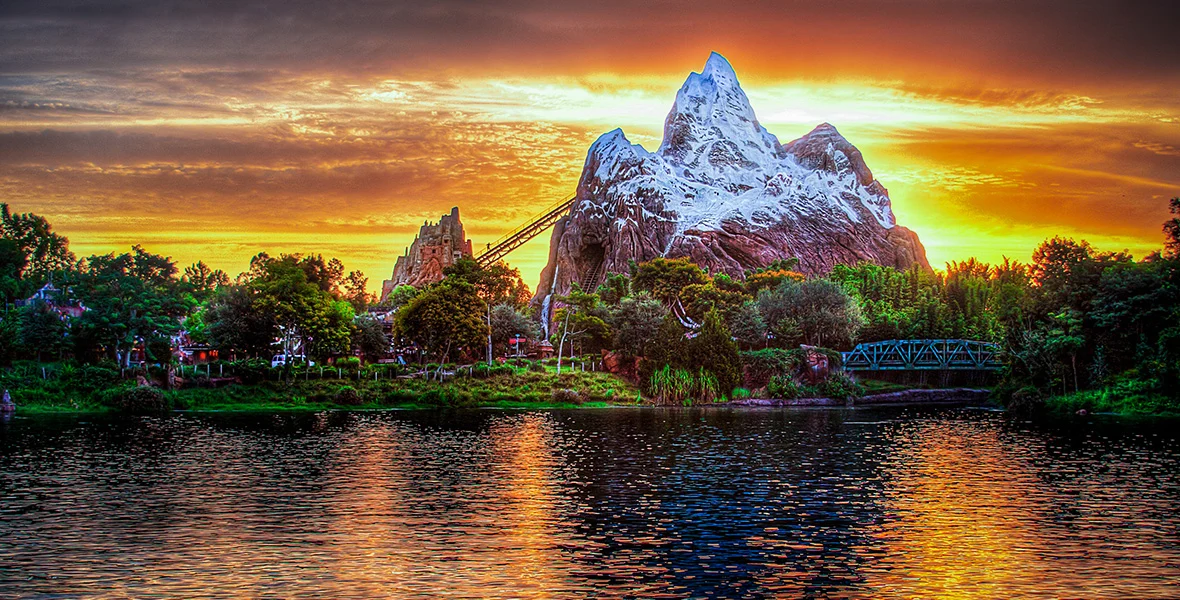
Expedition Everest’s railway and Yeti adventure are fictional. The research behind its setting was real. Imagineers traveled to the Himalayas, and Asian artisans supplied thousands of handcrafted objects for the attraction at Disney’s Animal Kingdom. D23’s account of the finished attraction and Joe Rohde’s own recollections show how fieldwork and fabrication helped build that world.
Keep four strands of the record separate as the story develops: personal travel, team research, a conservation expedition, and the attraction’s invented history. Their connections help explain the project. They do not make the sources interchangeable.
Rohde knew the region before the ride opened
Disney’s biography of Joe Rohde records a six-week Nepal journey in 1989. He hiked into mountain areas and encountered wildlife there. The biography places that travel within the wider story of developing Disney’s Animal Kingdom; it should not be relabeled as a dated Expedition Everest design trip.
Later came the attraction project. In a 2024 interview, Rohde separately recalled team research journeys and the conservation expedition called Mission Himalayas. His memory of entering Kagbeni included a helicopter arrival near the Kali Gandaki River and meeting a horse team. Read Rohde’s firsthand account for his description.
The account confirms travel and a strong personal connection to the region. It does not provide a day-by-day production itinerary or a date for every design decision. That is a useful boundary when retelling an adventure that could easily grow more dramatic with each repetition.
 © Disney / D23
Research was a team method
Rohde’s role was substantial, but he has repeatedly stressed collaboration. In a 2021 D23 interview, he described Animal Kingdom’s development as helping establish a design culture based on research, science and people outside Disney with their own expertise. His explanation of that working method is broader than one mountain or one ride.
That is a useful lens for Everest. Fieldwork is not simply a designer collecting attractive shapes. It can also mean asking people questions and learning what the design team does not already know. A convincing place requires more than a dramatic skyline.
Disney’s later biography calls Rohde the park’s overall creative executive and supervising designer, including expansions such as Everest. It also describes the high levels of cultural engagement involved in the park’s creation. The Disney Legends profile places the attraction within that larger career.
A scientific expedition ran alongside the attraction story
A December 2005 Disney announcement confirms a partnership with Discovery Networks and Conservation International on a Himalayan scientific expedition. It presented that work as a firsthand exploration connected with the Yeti legend and the coming attraction. The contemporary company announcement is evidence that this was more than a later recollection.
A scientific expedition associated with a legend is not proof that the creature in a roller coaster exists. Nor does the announcement establish that every detail of the finished ride came from that one journey. Rohde’s later interview itself distinguishes research trips from Mission Himalayas.
That distinction clarifies what each kind of work contributed. Travel could inform the setting, specialists could bring knowledge, and an invented story could organize the ride’s action. Following those separate contributions makes the achievement easier to understand.
 © Disney / D23
From a mountain face to a model
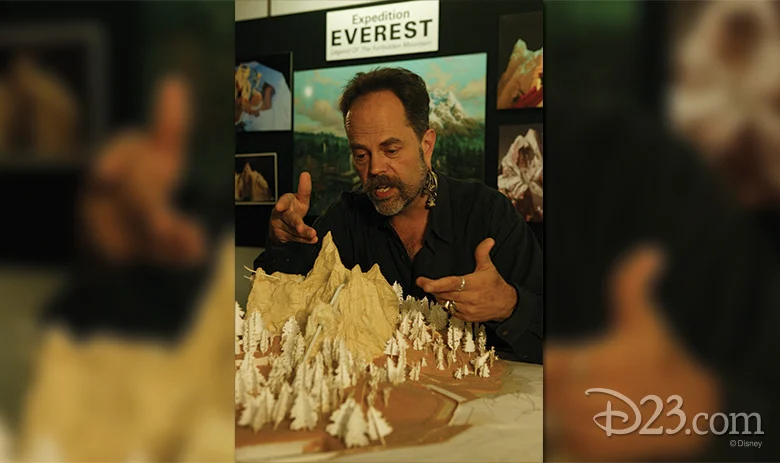
The Forbidden Mountain’s face drew on Mount Everest’s northwest face. D23 identifies the reference and shows Rohde with a scale model.
The photograph helps explain an important step between travel and construction. A landscape seen in the real world must become something a design team can examine at a smaller scale. A model allows separate pieces of a place to be considered together.
The result is a designed mountain in Florida, not an exact geographic copy of a Himalayan route. Its research gives the fantasy a visual foundation. The railway supplies a journey that the real mountain does not offer.
Objects brought another kind of detail
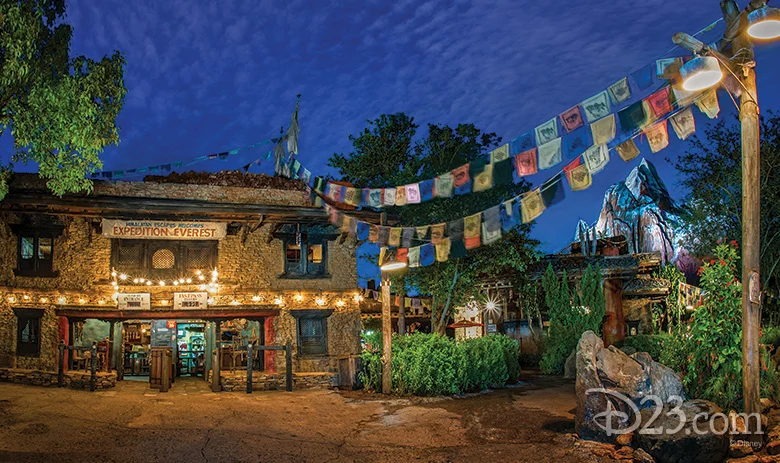
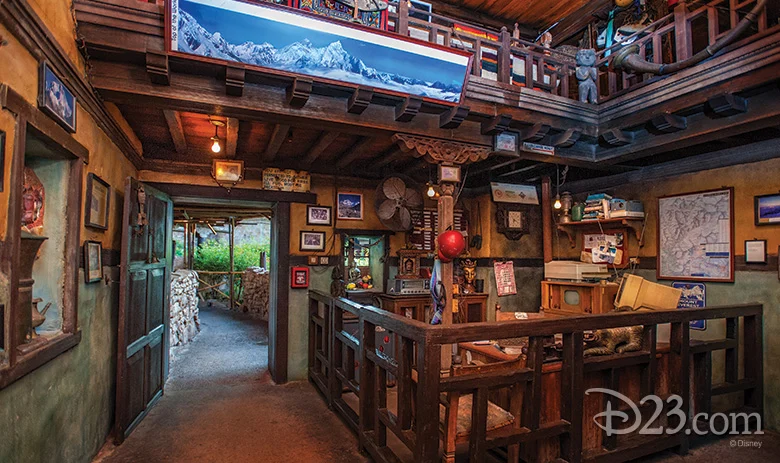
Asian artisans supplied more than 2,000 handcrafted objects in wood, stone and metal, according to D23’s account. The finished queue brings the setting down to a human scale.
It is worth separating that broad sourcing statement from claims about individual objects. The published source does not identify every item’s maker, age or original use. A room filled with details is not a reason to invent a biography for each one.
 © Disney / D23
The railway’s past belongs to the fiction
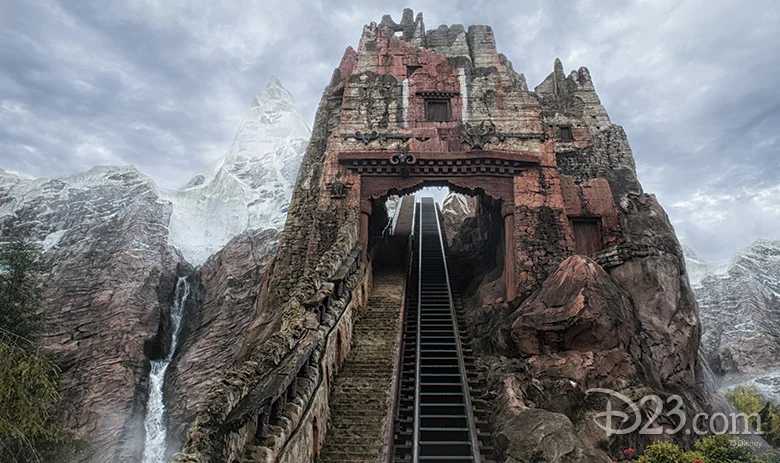
Serka Zong, the tea railway and the touring company belong to the attraction’s invented backstory. They are not historical railway records.
Keeping the real and invented material distinct does not weaken the design. It shows the job the research was doing: helping visitors accept a place long enough to enter its story. For more on that effect, explore how themed lands create a sense of place.
 © Disney / D23
Look below the skyline
On a future visit, start by noticing the approach, the rooms and the objects before looking up at the mountain. Ask which details establish everyday human life and which announce the ride’s invented danger.
The documented journeys gave the team firsthand experience to draw on. The craftspeople, models and story development turned that experience into a place guests could enter. That is the research story behind Everest: a team built an imagined adventure on a foundation of real travel and careful observation.
0 thumbs up0 thumbs down
Was it useful? Pick a thumb.
Guides & stories
Keep the good ideas coming.
A few next reads to help with the choices ahead.
For the places you’re exploring
One day at Disney’s Animal Kingdom: animals, shows and room to choose
Build a day around animals, a show and the ride your group wants most. This flexible route includes food, a proper rest and practical alternatives when plans change.
Read day plan
For the places you’re exploring
Disney’s Animal Kingdom ride plan: flight, mountains and a splash
Choose a manageable ride shortlist across Pandora, Asia and Africa. Compare the sensations, plan a meal and rest, and keep clear alternatives for weather, closures or a change of heart.
Read day plan
For the places you’re exploring
A slower Animal Kingdom day: wildlife, food and time to look
Give the animals, performances and settings more room in your day. This route keeps major rides optional, includes a full meal and separates an actual rest from more sightseeing.
Read day plan